Desktop Launcher Creator
Modern Linux desktops receive applications from at least three different worlds: Debian packages, Snap and Flatpak. Each has its own idea of where the application lives and, sometimes, whether it deserves an entry in the applications menu. The result is a familiar annoyance: a program you have installed is there, but you cannot find it — and there is no obvious way to create a launcher for it.
Desktop Launcher Creator is a small GTK application that fixes exactly that.
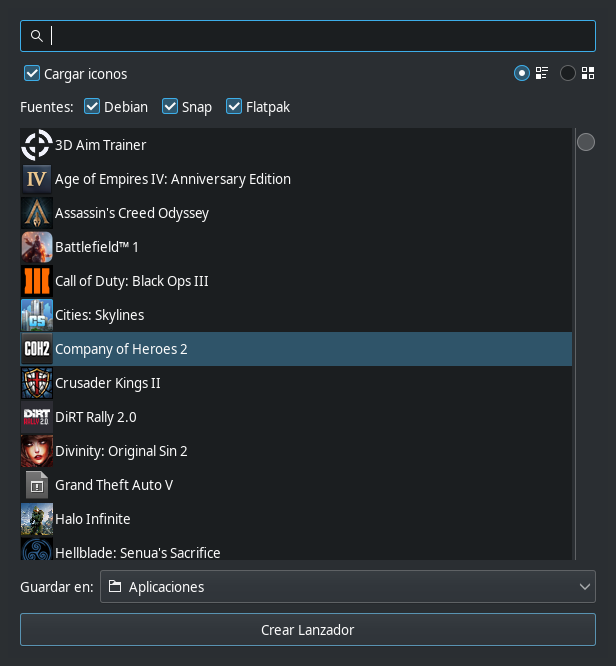
It scans the applications installed through Debian, Snap and Flatpak, shows them
in a simple list, and creates a .desktop launcher for whatever you select.
What it does
- Reads installed applications from the Debian, Snap and Flatpak sources.
- Shows them in a single list, so you can see what is actually installed.
- Creates a
.desktoplauncher for the one you pick, ready to appear in your applications menu.
The interface is intentionally minimal: a source selector (Debian | Snap | Flatpak), the list of applications, a destination and a single action button.
No configuration files to hand-edit, no guessing at Exec= lines.
How it is built
The application is written in Python 3.12 with GTK 3 (PyGObject and pycairo). It follows the same philosophy I keep coming back to: keep the core logic independent from the interface, and let the interface be an adapter. In this case the core is “enumerate installed applications and produce a launcher file”; the GTK window is just one way to drive it.
It is licensed under the GPL-3.0-or-later.
Getting it
Pre-built packages are attached to every release:
- Debian/Ubuntu:
.deb - Flatpak:
.flatpakbundle - Snap:
.snap - AppImage: portable
.AppImage - Python: wheel and source distribution (
.whl,.tar.gz)
You can find them under the Releases section of the project:
- GitHub: https://github.com/javi-jimenez/desktop-launcher-creator/releases
- Gitea (self-hosted): https://gitea.app.brisecom.net/gitea/desktop-launcher-creator/releases
Every release is built automatically from a tagged commit, so the artifacts and the source always match.