Introduction: The Universal Addressing Problem
The current Domain Name System (DNS) operates under terrestrial assumptions: latencies measured in milliseconds, concentrated physical infrastructure, and a central authority (ICANN). But what happens when we need to direct services in a Martian colony, in orbital stations, or even between star systems?
The DDNSC (Distributed DNS Cache) project provides the technical foundation to solve this problem by decentralized service publishing using standard protocols (RFC 2136, Avahi/Zeroconf). This article proposes a conceptual extension towards planetary, galactic and universal scales, integrating Web 3.0 technologies and emerging protocols.
The DDNSC Project: Technological Base
Current Architecture
DDNSC allows any node to publish its own services to remote DNS servers without centralized authorization:
- Client:
avahi-publish-remote.shscript usingnsupdate(RFC 2136) - Server: Bind with dynamically updateable zones
- Discovery: Avahi for service search (similar to mDNS/Bonjour)
- Distribution: Anycast to replicate DNS servers by zones
| |
Current Limitation: Scale ~1000 Nodes
The project itself acknowledges that scalability is limited to ~1000 nodes in its current form. We need true distributed architecture for larger scales.
Scalability: From Planetarium to Universal
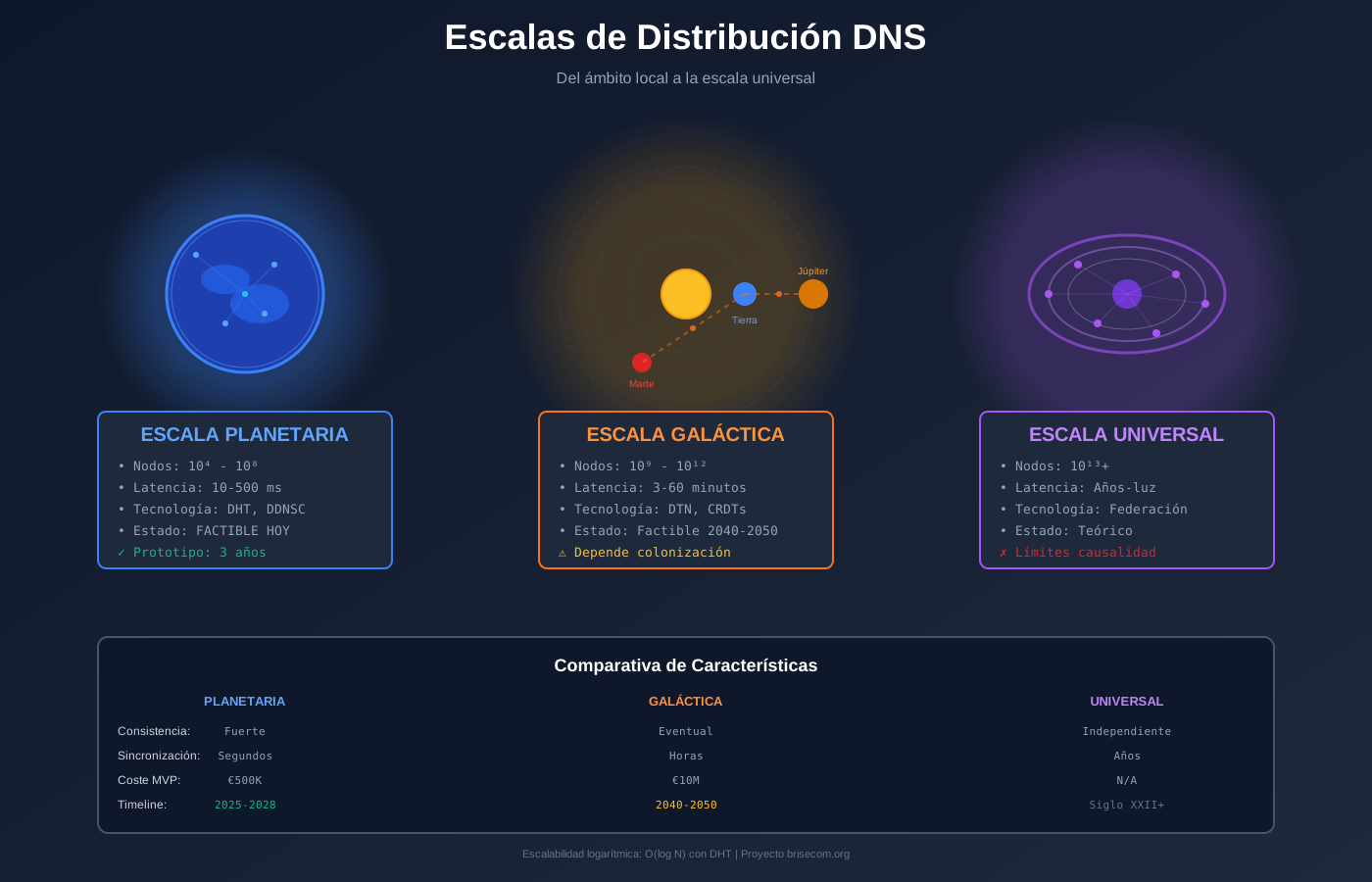
Level 1: Planetary Scale (10⁴ - 10⁸ nodes)
Context: Terrestrial community networks, massive IoT, smart cities.
Technical challenges:
- Maximum latency: 100-500 ms (terrestrial round-trip)
- Synchronization between time zones
- Resilience to regional network partitions
Proposed solutions:
Multi-layer geographic hierarchy:
1
2
.earth → .continent → .country → .region → .local example: server.barcelona.catalunya.europe.earthDHT (Distributed Hash Table) for resolution:
- Kademlia protocol (used in BitTorrent, IPFS)
- Each node maintains a table of ~log(N) neighbors
- Resolution in O(log N) steps
Lightweight blockchain for authority:
- Namecoin or Ethereum Name Service (ENS) for domain registration
- Proof-of-Authority instead of PoW for efficiency
Capacity calculation:
| Parameter | Value |
|---|---|
| Total nodes | 10⁸ (100 million) |
| DHT table size per node | log₂(10⁸) ≈ 27 entries |
| Memory per entry | 100 bytes (ID + IP + metadata) |
| Total memory per node | 2.7KB |
| Average resolution jumps | log₂(10⁸)/2 ≈ 14 hops |
| Hop Latency | 20 ms (earth average) |
| Total resolution time | ~280ms |
Level 2: Galactic Scale (10⁹ - 10¹² nodes)
Context: Colonized solar system (Moon, Mars, asteroid belt, moons of Jupiter/Saturn).
Technical challenges:
- Variable latency: 3 min (Earth-Mars at close opposition) to 22 min (far opposition)
- Network partitions unavoidable during solar conjunctions
- Constant orbital movement of the nodes
Proposed solutions:
Eventual consistency model:
- CRDT (Conflict-free Replicated Data Types) for DNS records
- Inspired by CassandraDB and Amazon Dynamo
- Each planet maintains full cache with timestamps
Delay-Tolerant Networking (DTN) Protocol:
- RFC 4838 - Bundle Protocol
- Used by NASA in deep space communications
- Store-and-forward with scheduled recognitions
Predictive resolution:
- Precalculate orbits and communication windows
- Proactive cache based on ephemeris
- Algorithm: “Resolve before request”
Proposed hierarchy:
| |
Interplanetary latency calculation:
| Route | Min distance (AU) | Light latency (min) | Communication window |
|---|---|---|---|
| Earth-Moon | 0.0026 | 1.3 seconds | Continued |
| Earth-Mars | 0.38 | 3.2 | 80% of the year (avoiding conjunctions) |
| Earth-Jupiter | 4.2 | 35 | 70% of the year |
| Earth-Saturn | 8.0 | 67 | 65% of the year |
| Earth-Oort Cloud | 50,000 | 0.8 years | Relay required |
Level 3: Universal Scale (10¹³+ nodes)
Context: Multi-stellar civilization (hard science fiction, theoretical research project).
Technical challenges:
- Light-year latencies (4.2 years to Alpha Centauri)
- Physical impossibility of global consensus
- Conceptual equivalence with disconnected universes
Proposed model: “Federation of DNS Universes”:
Each star system operates as independent DNS universe with optional federation:
Absolute local authority:
- Each star is TLD:
.alphacen,.sirius,.kepler442 - Does not require consensus with other systems
- Communal ownership of the star system
- Each star is TLD:
Interstellar Relay:
- Ships traveling between systems carry “upgrade packages”
- Similar to Sneakernet but on an interstellar scale
- Protocol: “eventual consistency with years of delay”
Optional Federated Names:
1
2
.galaxy.milkyway → .arm → .sector → .system → .planet example: station.newearth.alphacen.orion.milkyway.galaxy
Theoretical capacity calculation:
| Scale | Estimated nodes | Full Sync Time |
|---|---|---|
| Solar system | 10⁹ | Hours (DTN) |
| 100 light-years (local sphere) | 10¹² | Centuries (real-time synchronization impossible) |
| Milky Way Galaxy | 10¹⁵ | 100,000 years (historical federation only) |
| Observable universe | 10²⁴+ | Impossible (physical causality) |
Organization: Decentralized Governance
Model for brisecom.org
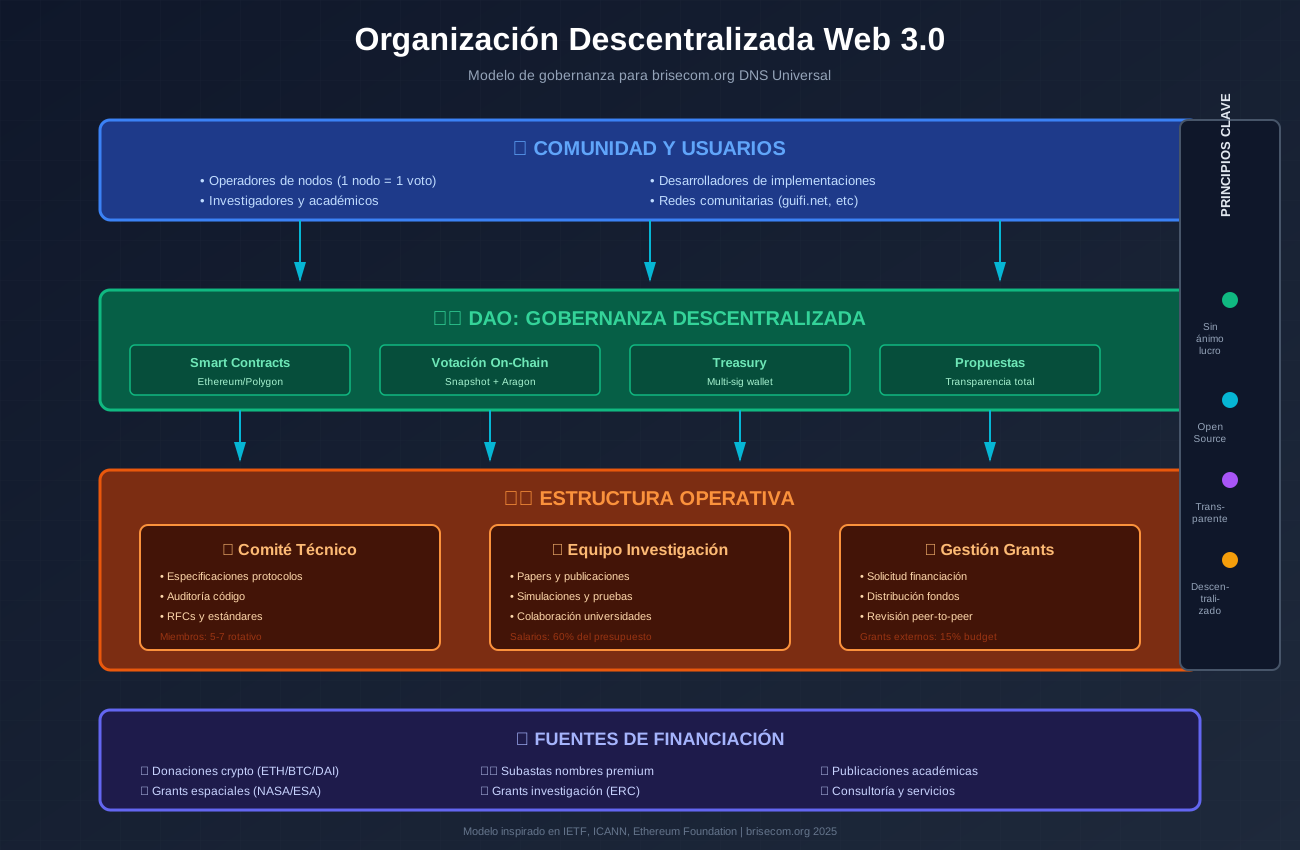
Organizational proposal inspired by the Internet Engineering Task Force (IETF) and ICANN, but decentralized:
Foundation Structure
Technical Committee (5-7 members)
- Protocol specifications
- Implementation audit
- Review of RFCs
Governance Council (rotating, contribution-based)
- Assignment of planetary/galactic TLDs
- Name conflict resolution
- Voting: 1 active node = 1 vote
Research Grants
- Financing through cryptocurrencies (DAO)
- Peer-to-peer review of proposals
- Total transparency in blockchain
Financing Model
| |
Web 3.0 Governance
DAO (Decentralized Autonomous Organization) for critical decisions:
Smart contract on Ethereum:
- Each protocol implementation = 1 voting token
- On-chain proposals with voting period
- Automatic execution of approved decisions
IPFS for storage:
- Historical DNS records in IPFS
- Content addressing:
/ipns/ddnsc.brisecom.org - Immutability and censorship-resistant
Related Protocols and Projects
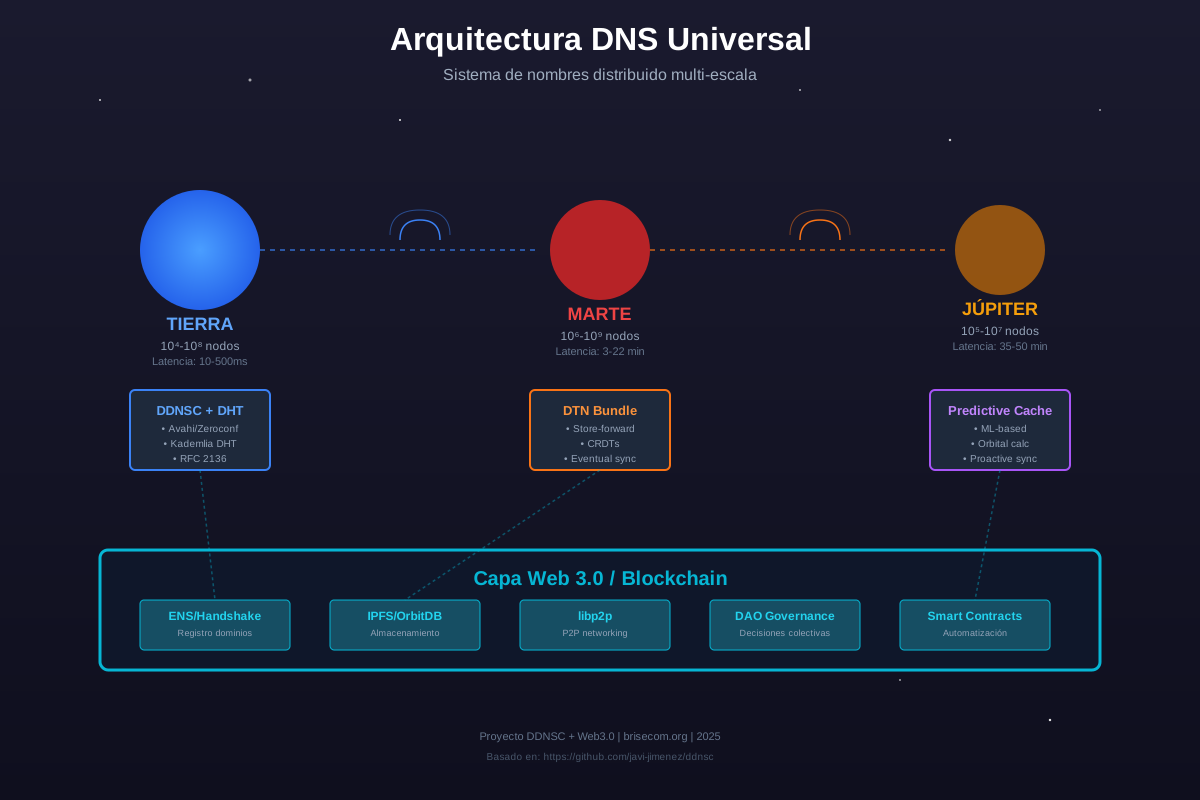
Web 3.0 Ecosystem
| Project | Relevance | Proposed integration |
|---|---|---|
| ENS (Ethereum Name Service) | Decentralized names on blockchain | Authority backend for premium TLDs |
| IPFS/IPNS | Content-addressed distributed storage | DNS zone replication, distributed cache |
| libp2p | Peer-to-peer networking stack | Transport layer for DDNSC nodes |
| Handshake (HNS) | Decentralized Alternative DNS Blockchain | Competitor/plugin for root registry |
| OrbitDB | Distributed database over IPFS | Storing dynamic DNS records |
| GNUnet Name System (GNS) | Secure and decentralized naming system | Inspiration for resolution with privacy |
Space Communication Protocols
| Protocol | Standard | Application in Universal DNS |
|---|---|---|
| DTN Bundle Protocol | RFC 4838, RFC 5050 | Transporting DNS updates with high latency |
| CCSDS File Delivery Protocol | CCSDS 727.0-B-5 | Full zone synchronization |
| Licklider Transmission Protocol | RFC5326 | Reliable sessions on intermittent links |
| Proximity-1 Space Link Protocol | CCSDS 211.0-B-5 | Physical layer for interplanetary communications |
Integration Architecture
| |
Open Research Areas
1. Resolution with Extreme Latency
Problem: Resolving colony.mars.sol from Earth when Mars is behind the Sun.
Hypothesis:
- ML-based “proxy predictions” system
- Smart cache that learns query patterns
- Model: “If I can’t ask, I predict the probable answer”
Proposed experiment: Simulate node network with scheduled latencies (3-22 random minutes) and measure predictive cache hit rates vs. traditional LRU cache.
Estimated funding: €50,000 (1 year, 1 postdoc researcher + infrastructure)
2. CRDT for DNS Records
Problem: Two nodes update the same name simultaneously on different planets.
Proposal: Implement CRDT (LWW-Element-Set) for A/AAAA/SRV records.
Technical challenge:
- Timestamps require clock synchronization
- In space: GPS does not work, we need to press timing
- Alternative: Vector clocks with logic counter
Prototype code:
| |
Estimated funding: €80,000 (18 months, implementation + paper)
3. Space Name Economy
Question: How much is olympus.mars worth? Who controls it?
Proposed model:
- ENS-style auctions with smart contracts
- Revenue finances relay infrastructure
- “Homesteading”: first to colonize = first to register
Socioeconomic research:
- Acceptance studies with spatial communities
- Simulation of secondary markets
- Analysis of interplanetary intellectual property
Estimated funding: €120,000 (2 years, interdisciplinary team: space law + economics + engineering)
4. Security without Centralized PKI
Issue: DNSSEC depends on root keys controlled by ICANN. Impossible in interstellar federation.
Alternatives:
- Web of Trust (PGP-style) between star systems
- Blockchain as a root of trust (each system publishes its public key)
- Quantum-resistant signatures for records that will last centuries
Experiment: Implement DNSSEC with Ed25519 (post-quantum) on the Ethereum blockchain as an alternative root of trust.
Estimated funding: €100,000 (2 years, crypto expert + blockchain developer)
5. Galactic Network Simulation
Objective: Software that simulates a 10¹² node network with realistic orbital latencies.
Components:
- Orbital physics engine (precise ephemeris)
- Network protocol simulator (ns-3 extended)
- 3D dynamic topology viewer
- Benchmark of resolution algorithms
Deliverables:
- Open-source framework
- Synthetic trace dataset
- Papers at networking conferences (SIGCOMM, NSDI)
Estimated funding: €200,000 (3 years, 2 software engineers + HPC cluster)
Calculations and Estimates
Required Bandwidth
For complete planetary DNS zone update:
| |
Blockchain Consensus Energy Cost
Lightweight Blockchain (Proof-of-Authority with 100 validators):
| |
DHT Scalability
For N nodes, each maintains k neighbors (typically k = 20):
| N (nodes) | log₂(N) | Memory/node | Average jumps | Resolution latency (50ms/hop) |
|---|---|---|---|---|
| 10³ | 10 | 2KB | 5 | 250ms |
| 10⁶ | 20 | 4KB | 10 | 500ms |
| 10⁹ | 30 | 6KB | 15 | 750ms |
| 10¹² | 40 | 8KB | 20 | 1000ms |
Conclusion: DHT scales logarithmically, viable up to full planetary scale.
Conclusion: Feasibility and Next Steps
Is it Feasible?
Planetary scale (10⁸ nodes): YES, feasible now
- Technology exists (DHT, blockchain, DDNSC)
- Pilot project: guifi.net community network (~38,000 nodes currently)
- Estimated cost: €500K for MVP in 3 years
Galactic scale (solar system): Feasible in 20-30 years
- Depends on space colonization (NASA Artemis, SpaceX Starship)
- DTN already tested by NASA
- Estimated cost: €10M for functional prototype
Universal scale: Theoretically interesting, physically impossible
- It would violate relativistic causality
- Valid as an extreme systems design exercise
- Terrestrial applications: simulation of ultra-distributed networks
Roadmap for brisecom.org
Phase 1 (Years 1-2): Foundations
- Implement DDNSC with DHT (Kademlia)
- PoC with 1000 simulated nodes
- Paper in conference (NSDI/SIGCOMM)
- Cost: €150K (2 fullstack engineers)
Phase 2 (Years 2-4): Web 3.0 Integration
- Backend with ENS + IPFS
- DAO for governance
- Pilot network with 10K real nodes
- Cost: €300K (blockchain expert + 2 devs)
Phase 3 (Years 4-6): Space Simulation
- Orbital simulation framework
- Collaboration with ESA/NASA
- Space research grants
- Cost: €500K (HPC cluster + team of 4)
Phase 4 (Years 6-10): Actual Deployment
- Experiment on ISS or lunar mission
- Licenses and patents
- Commercial spin-off
- Cost: €2M (depends on space partners)
Suggested Financing
Immediate sources:
- European Research Council (ERC Starting Grant): €1.5M
- Horizon Europe (Cluster 4 - Digital & Space): €2M
- ESA Open Space Innovation Platform: €500K
- Ethereum Foundation Grants: €200K
- Crypto crowdfunding (DAI/ETH): €100K
Total available potential: €4.3M for 5 years
Your salary: €60K-80K/year (competitive for senior researcher in Spain), sustainable with €300K annual budget.
References and Links
- DDNSC GitHub: https://github.com/javi-jimenez/ddnsc
- RFC 2136 - Dynamic Updates in DNS: https://tools.ietf.org/html/rfc2136
- RFC 4838 - Delay-Tolerant Networking: https://tools.ietf.org/html/rfc4838
- ENS Documentation: https://docs.ens.domains/
- IPFS Specifications: https://specs.ipfs.tech/
- Handshake Whitepaper: https://handshake.org/files/handshake.txt
- NASA Deep Space Network: https://www.nasa.gov/directorates/heo/scan/services/networks/dsn
- Kademlia DHT: Maymounkov & Mazières (2002) - Peer-to-peer information system
- CRDTs: Shapiro et al. (2011) - Conflict-free Replicated Data Types
Author’s note: This article is based on research and analysis of the open source DDNSC project. The text has been generated with the help of artificial intelligence based on real technical concepts of distributed systems, spatial networking protocols, and Web 3.0 architectures. The calculations are theoretical approximations for research purposes.
For brisecom.org: This work represents an initial proposal for a line of research. Peer-to-peer review and feedback from the science and space community is requested before proceeding with funding applications.